
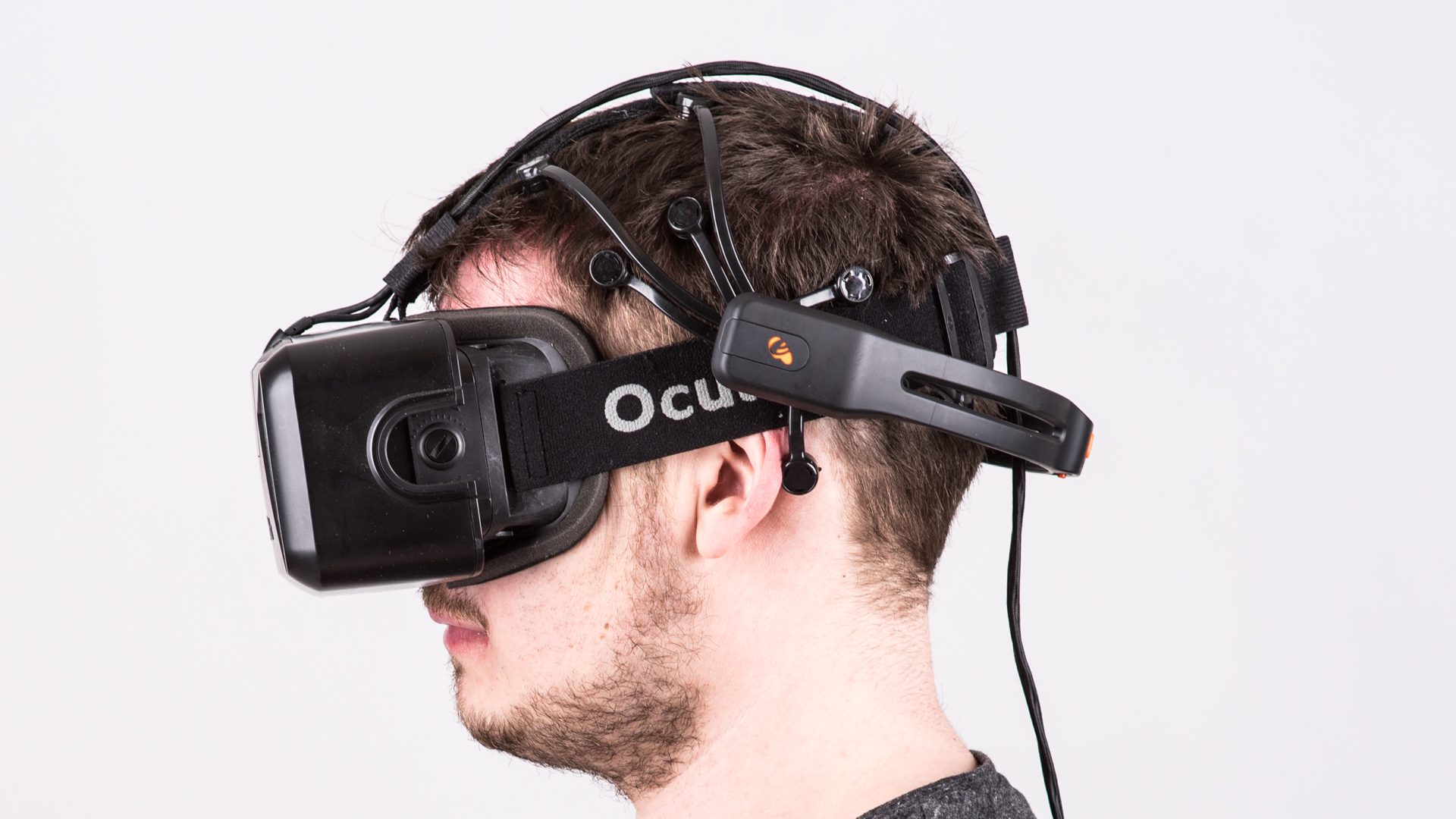
How do we bridge the gap between digital logic and the human subconscious? In 2015, I developed Ride Your Mind, an installation that fused a 14-channel electroencephalogram (EEG) headset, a virtual reality cave setup, and a custom-trained neural network.
Traditional interfaces rely on muscle movements—clicks, gestures, voice. Ride Your Mind bypassed physical actions entirely. The system measured raw brainwaves (alpha, beta, theta, delta) and fed them directly into a machine learning model that translated subconscious emotional states into dynamic world parameters in real time.
"The world was the mind. The AI acted as a biological translator, not an author."
If the player's mind shifted, the virtual landscape evolved. If they experienced focus, the spatial geometries stabilized; if they fell into distraction, the system dissolved. The world was the mind, translated by algorithms.
This project demonstrated a new paradigm for human-machine interaction: the machine not as a tool that we command, but as a biological mirror that responds to our internal state. It remains a vanguard reference for serious game design and neuro-interactive experiences.